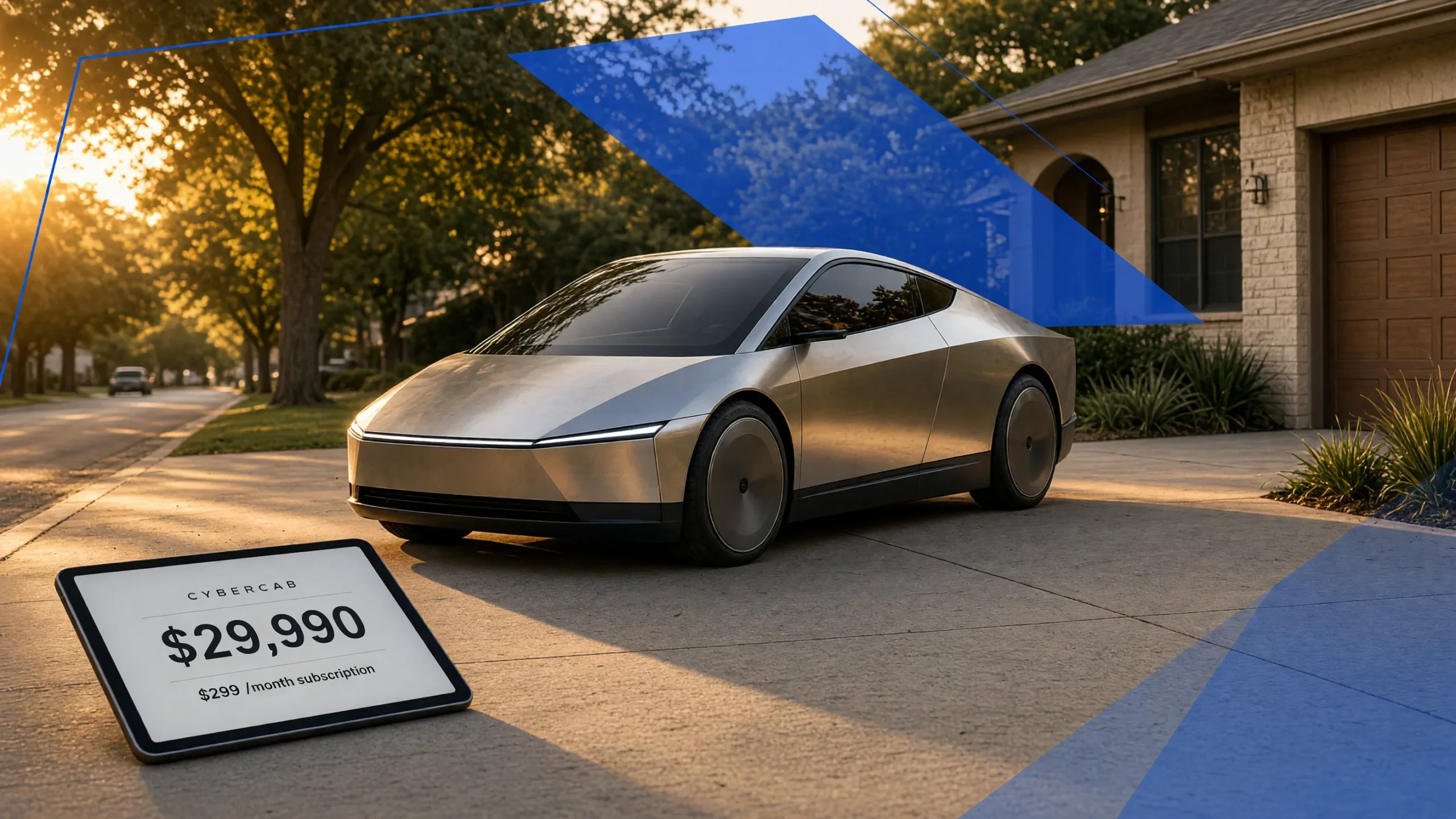
Tesla Expands Cybercab Availability Through Exclusive Private Invitations
Tesla has officially initiated the next phase of its autonomous transport strategy by opening Cybercab purchases to a select group of private buyers. According to recent reports, the invitation-only opportunity allows targeted customers to secure early reservations for the fully autonomous vehicle, with initial deliveries slated to begin in Austin, Texas, as early as December.
The move represents a notable evolution in Tesla’s commercialization strategy for its dedicated robotaxi platform. Rather than limiting the fleet exclusively to corporate-managed ride-hailing services, the electric vehicle maker is integrating private ownership into its rollout strategy, albeit under strictly controlled conditions and software agreements.
Mandatory Subscription Model and Ownership Terms
Early documentation associated with the private purchase offer indicates that owning a Cybercab comes with unique operational conditions distinct from traditional consumer vehicles. Key details of the ownership framework include:
- Exclusive Invitation Access: Early purchasing rights are currently limited to selected high-profile supporters, long-time Tesla owners, and corporate partners.
- Austin-First Deliveries: Initial vehicle handovers are scheduled to take place in Austin, Texas, where Tesla maintains its global headquarters and major production facilities.
- Mandatory Monthly Subscription: Owners must pay a mandatory $299 monthly subscription fee, which covers software updates, autonomous fleet connectivity, and network integration.
- Commercial Taxi Restrictions: Personal ownership of the Cybercab does not automatically grant the owner permission to deploy the vehicle on commercial ride-hailing networks.
The compulsory $299 monthly fee underscores Tesla’s commitment to building a software-as-a-service (SaaS) revenue engine alongside hardware sales. By locking hardware functionality into an active cloud connection and subscription infrastructure, Tesla ensures continuous monetization over the lifetime of each vehicle.
Commercial Fleet Deployment vs. Personal Ownership
One of the most critical aspects of the purchase agreement revolves around commercial operation permissions. While buyers can take physical possession of a Cybercab, Tesla explicitly notes that personal ownership does not grant authorization to operate the vehicle as an autonomous commercial taxi.
In municipal markets across North America, operating a commercial passenger service requires extensive local regulatory approvals, commercial insurance policies, and specialized transport licenses. By separating vehicle title ownership from commercial ride-hailing rights, Tesla retains tight control over how and when Cybercabs enter public transportation networks.
Industry analysts suggest that Tesla may eventually allow private owners to enroll their vehicles into a shared Tesla Network fleet, earning passive income when the cars are not in personal use. However, during the initial deployment phase in Austin, the primary emphasis appears to be on data collection, real-world validation, and controlled operational trials under Tesla’s direct supervision.
The Architectural Shift: A Car Without Controls
The Cybercab stands out in the automotive industry due to its radical design philosophy. Unlike standard passenger vehicles equipped with Full Self-Driving (FSD) capabilities, the Cybercab features no steering wheel, accelerator pedal, or brake pedal. Its interior is configured purely for passenger comfort, featuring a minimalist two-seat arrangement centered around a prominent touchscreen interface.
This design choice creates both opportunities and hurdles:
- Cost Optimization: Removing traditional driver controls reduces manufacturing complexity, weight, and assembly costs.
- Inductive Charging: The Cybercab relies on wireless inductive charging systems rather than traditional charging cables, enabling automated depot servicing without human intervention.
- Regulatory Scrutiny: Operating a vehicle without manual controls requires federal exemptions from National Highway Traffic Safety Administration (NHTSA) standards, which traditionally assume a human driver is present.
Why Austin Serves as the Launch Pad
Choosing Austin, Texas, as the initial delivery point is a strategic move for Tesla. Beyond proximity to Gigafactory Texas, the state offers a regulatory environment that is generally supportive of autonomous vehicle testing and commercial deployment compared to states like California.
Texas law allows autonomous vehicles to operate on public roads without a human driver, provided the vehicle complies with state traffic laws, is equipped with recording equipment, and maintains appropriate insurance coverage. By launching in Austin, Tesla minimizes administrative delays and establishes a baseline for suburban and urban autonomous mobility.
Competitive Landscape in the Autonomous Vehicle Industry
Tesla’s Cybercab rollout places it in direct competition with established autonomous vehicle operators who have accumulated millions of commercial driverless miles:
- Waymo (Alphabet): Currently leads the market with fully driverless commercial ride-hailing services active in Phoenix, San Francisco, Los Angeles, and expanding to Austin.
- Zoox (Amazon): Developing custom-built, bidirectional autonomous shuttles designed specifically for urban mobility.
- Cruise (General Motors): Restructuring its autonomous deployment strategy following safety reviews and regulatory pauses in 2023.
Unlike Waymo and Zoox, which rely on expensive LiDAR and radar sensor suites, Tesla’s approach relies exclusively on computer vision and vision-based neural networks. This camera-only strategy allows Tesla to target dramatically lower manufacturing costs per vehicle, aiming for a consumer-accessible purchase price that could disrupt traditional vehicle ownership paradigms.
Looking Ahead: Scaling Production and Software Validation
As the December delivery window approaches for Austin invitees, automotive observers will closely monitor how early owners utilize the vehicles and how effectively Tesla manages autonomous software performance in real-world scenarios.
The success of this early invite-only launch will likely dictate how quickly Tesla expands Cybercab availability to broader consumer markets and additional cities worldwide. While regulatory approvals and technical milestones remain critical variables, opening sales to private buyers represents a decisive step forward in bringing fully autonomous personal transport to market.
